
ERA 2025 tipping duties start 1 January 2027 — what hospitality operators need to do now
The Employment Rights Act 2025 adds worker consultation obligations on top of EATA. Here's what changes, what you need to document, and why starting now matters.
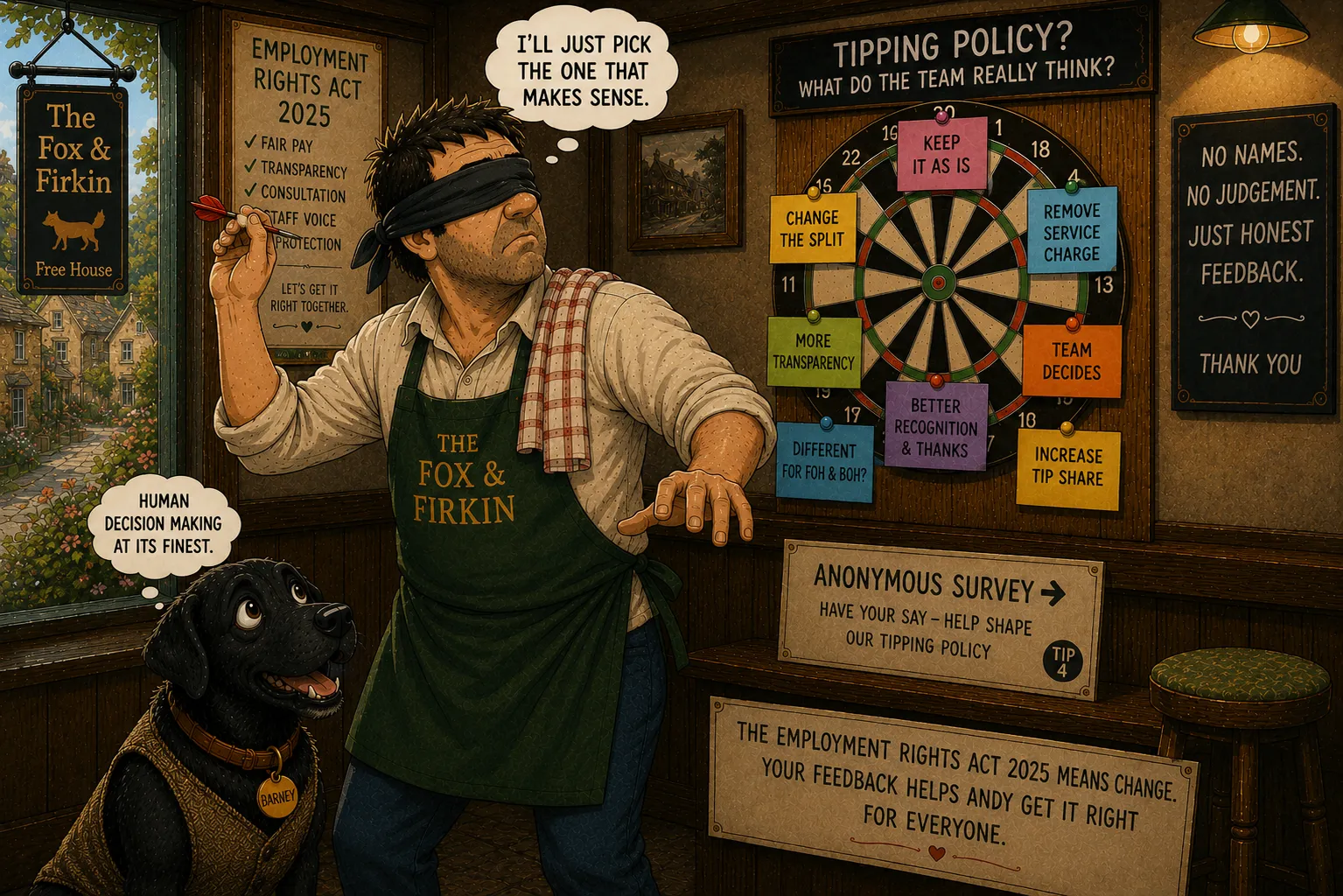
Most hospitality operators have heard of the Employment (Allocation of Tips) Act 2023 — EATA — and broadly understand that tips now have to go to workers in full, fairly, and on time. What many haven't yet absorbed is the second wave of legislation sitting behind it.
The Employment Rights Act 2025 (ERA) brings in new tipping duties from 1 January 2027. Earlier guidance pointed to 1 October 2026, but the government's timetable, updated on 22 October 2026, moved the date. For tipping specifically, ERA adds a new layer: a worker consultation process that must happen before your tipping policy is set or changed. That means anonymous feedback, documentation, and a clear record that workers' views were taken on board. Source: Plan to Make Work Pay and Employment Rights Act: timeline update, GOV.UK.
What EATA already requires
Before covering ERA, it's worth being clear on what EATA already demands — because many operators are still not fully compliant with the 2023 Act, let alone the 2025 one. Under EATA you must pass 100% of tips to workers with no deductions, maintain a written tipping policy accessible to all workers, distribute tips fairly and document how fairness is determined, pay tips no later than the end of the following month, keep records for 3 years, and respond to worker requests within 4 weeks.
If you get it wrong, a worker can take you to an employment tribunal. The tribunal can order you to pay the tips that are owed, plus compensation of up to £5,000 on each claim. That £5,000 is the compensation cap set by the Employment (Allocation of Tips) Act 2023. It is a tribunal award to the worker, not an HMRC fine. Source: Employment (Allocation of Tips) Act 2023, legislation.gov.uk.
What ERA 2025 adds
ERA builds on EATA by requiring that workers are actively consulted before a tipping policy is adopted or changed. Workers must be able to give feedback anonymously — an open meeting doesn't satisfy the requirement. You need a documented mechanism. Their feedback must demonstrably be taken on board, and the final policy must be communicated back to workers in an accessible format. The policy must then be reviewed at least every three years.
Why 1 January 2027 is closer than it sounds
The consultation process itself takes four to six weeks done properly. If you haven't started by November, you're cutting it close. Tip4 has the ERA consultation tooling built into the platform — anonymous worker feedback, policy generation, audit pack assembly, all timestamped and Tribunal-ready from day one.
Tony Berry walks through the full set-up, step by step, in how to set up a tronc scheme. Who should run the tronc is in what is a troncmaster?, and what to tell customers about tipping on the card machine is in electronic tipping: how it works.